Bringing Enterprise AI Inside the Local Network
How AIplay enabled CAOA clients to use advanced AI without sending business data to the internet — a fully private enterprise AI environment using Gemma 4 26B A4B deployed inside the organisation's own network.
Back to Case Studies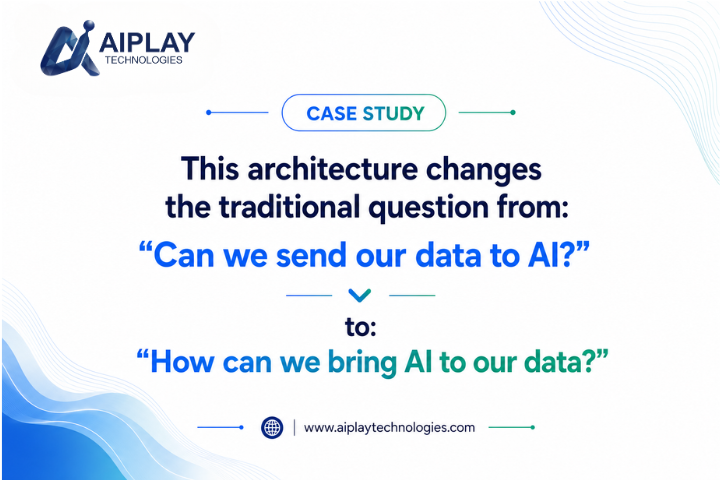
Enterprise AI Capabilities — Without Leaving the Network
Many organisations want to use AI across their ERP systems — but sensitive business data creates a major concern. For accounting and professional-services firms, ERP data can include client information, financial records, employee data, documents, tasks, reports, and other confidential business data.
Sending this information to a cloud-based LLM may not be acceptable for organisations with strict security, privacy, or compliance requirements. AIplay Technologies addressed this challenge by enabling selected CA Office Automation (CAOA) clients to deploy an AI environment inside their own local network.
The solution uses Gemma 4 26B A4B, a Mixture-of-Experts model with approximately 25.2B total parameters while activating about 3.8B parameters during inference. Google positions this model for deployment on desktop computers and small servers — making it particularly well-suited for private AI environments.
The Result: A private AI environment where CAOA's AI capabilities operate against controlled enterprise data — without sending application data to any external LLM service.
- Challenge
- Business data security — cannot send ERP data to external AI services
- Solution
- Private Enterprise AI Architecture with locally deployed LLM inside the organisation's network
- Platform
- CA Office Automation (CAOA) ERP
- AI Model
- Gemma 4 26B A4B (MoE, 256K context)
- Published
- August 2026
The Requirement Was Simple — and Non-Negotiable
Cloud AI provides tremendous capabilities, but some organisations have a straightforward requirement: "Our business data must stay inside our network."
Traditional cloud AI integration creates a data flow that routes enterprise information outside the organisation's controlled environment:
For security-sensitive organisations, this architecture is not acceptable.
For accounting and professional-services firms using CAOA, the ERP environment contains highly sensitive data across every business function:
- Client information & records
- Financial data & accounts
- Employee information
- Business documents & files
- Tasks & workflow data
- Confidential reports
The alternative was not to avoid AI entirely — it was to bring the intelligence inside the organisation's infrastructure, where the data already lives.
Private Enterprise AI Architecture
AIplay designed a Private Enterprise AI Architecture in which the LLM, AI services, and enterprise data all remain within the organisation's controlled network — with no external LLM calls required.
The architecture places every component of the AI stack inside the organisation's own environment. CAOA data never leaves the network boundary. The LLM processes requests locally, and AI responses are returned directly to internal applications.
- CAOA ERP data remains on the local network at all times
- AI processing happens on the organisation's own infrastructure
- No business data is transmitted to any external LLM endpoint
- The AI layer integrates with CAOA's existing reports, documents, clients, and tasks
- Internal applications receive AI responses directly — no cloud round-trip
No External LLM Call — AI processing stays fully inside the local network boundary.
Why Gemma 4 26B A4B?
The selected model is based on Google's open-weight Gemma 4 family — specifically designed to balance large model capacity with efficient local inference.
Mixture-of-Experts Architecture
The 26B A4B version uses MoE architecture: approximately 25.2B total parameters with only ~3.8B active parameters during inference. This provides large model capability with manageable compute requirements for local deployment.
256K Token Context Window
A 256K-token context window allows the local model to work with large enterprise documents, multi-source business data, and extended business contexts — well beyond the needs of typical enterprise AI workloads.
Built for Local Deployment
Google explicitly positions Gemma 4 for deployment on desktop computers and small servers, with local deployment paths including Transformers and vLLM. The 26B A4B model is a recommended starting point for enterprise tasks with lower resource requirements than larger models.
Why This Architecture Matters for Private AI
More Than a Local Chatbot
The objective was not simply to install an LLM on a server. AIplay integrated the local model with CAOA's existing AI capabilities — turning it into a true enterprise AI layer rather than an isolated assistant.
The architecture allows the local AI environment to work with the full range of approved internal data sources available within the CAOA environment:
Gemma 4 supports reasoning and agentic workflows, as well as tool and function calling — providing a foundation for connecting the model to application capabilities within the enterprise environment.
Multi-Source Enterprise Intelligence
One particularly powerful capability is the ability to combine information from different internal sources. The AI can answer questions that require data from multiple approved CAOA sources — not just a single application view.
Automated Compliance Reporting
The architecture enables complex enterprise workflows — such as compliance reporting — to be handled by the local AI layer, from data collection through to a structured final output.
Previously
With the Local AI Environment
CAOA Data + Internal Documents
Approved data sources are identified and retrieved from within the local network.
Business Rules + Compliance Requirements
The organisation's rules, terminology, required report structure, and output format are defined and passed to the AI layer.
Local AI Analysis & Reasoning
The local Gemma 4 model analyses the data, applies business rules, and generates compliance findings — entirely within the private network.
Structured Report Output
The AI produces a report in the required format and terminology, ready for human review.
Human Review & Finalisation
A human reviews and approves the AI-generated output before finalising the report.
Four-Layer Private AI Architecture
The solution is structured as four major layers — each operating entirely within the organisation's local environment.
Enterprise Data Layer
- CAOA database
- Documents & reports
- Internal files
- Internal applications
- Other enterprise databases
AI Integration Layer
- Authentication
- Data access & context preparation
- Prompt orchestration
- Permission enforcement
- AI service routing
- Output processing
Local AI Layer
- Gemma 4 26B A4B (locally deployed)
- Inference / runtime environment
- AI-specific configurations
- Reasoning & response generation
Application Layer
- CAOA ERP
- Internal applications
- Reporting interfaces
- AI assistants
- Enterprise workflows
How an AI Request Flows
User Request via CAOA / Internal Application
A user submits a query or triggers an AI workflow inside the CAOA application.
Authentication & Permission Check
The AI Integration Layer verifies the user's identity and access permissions before proceeding.
Identify & Retrieve Approved Business Data
Required internal data sources are identified and the approved context is retrieved from within the local network.
AI Prompt & Context Orchestration
The integration layer prepares the prompt with the retrieved business context for the local model.
Local Gemma 4 26B A4B — Reasoning & Response
The local model processes the request and generates a response entirely within the organisation's environment.
Response Validation, Formatting & Delivery
The output is validated and formatted before being returned to the CAOA application or internal workflow — with no data leaving the local network at any step.
Tuned for CAOA AI Workloads
A generic local LLM is not automatically an enterprise AI solution. AIplay configured the local AI environment around the actual CAOA use cases — optimising the model and surrounding orchestration for real business workloads.
The AI Improvement Loop
An important part of the architecture is that the system can be continuously improved based on controlled enterprise feedback — following a governed improvement cycle rather than uncontrolled self-modification.
This should not be interpreted as the model automatically retraining itself from every user interaction. AIplay's approach uses controlled feedback, evaluation, prompt and orchestration improvements, and governed tuning to progressively improve the organisation's AI experience. That distinction is important for enterprise governance.
From Local LLM to an AI-Powered Network
The long-term vision extends beyond a single model deployment. Once a governed AI layer is available locally, multiple internal applications can consume the same controlled AI infrastructure — creating the foundation for a private AI ecosystem across the organisation's internal network.
This architecture changes the traditional question that many organisations face when considering AI adoption:
"Can we send our data to AI?"
"How can we bring AI to our data?"
That is a fundamental shift for organisations with strict data-security requirements. It allows them to explore advanced AI capabilities while retaining greater control over data location, network boundaries, access permissions, AI workloads, application integration, model selection, and governance.
What This Architecture Delivers
Six capabilities that define the value of a private, locally deployed enterprise AI environment.
Key Takeaways
Keep the Data Inside. Bring the Intelligence Inside. Connect AI to the Enterprise.
AI adoption does not always require moving enterprise data to the cloud. AIplay's Local LLM implementation demonstrates another path.
By combining CAOA, a locally deployed Gemma 4 26B A4B model, enterprise data connectors, AI orchestration, and controlled improvement workflows, AIplay enables organisations to explore powerful AI capabilities while maintaining a private AI processing environment.
For organisations with strict data-security requirements, Local AI can become more than an alternative to cloud AI — it can become the foundation of their private enterprise AI strategy.
AIplay Technologies — Bringing AI to Where Your Data Lives.